
Artificial intelligence is rapidly becoming part of everyday business operations. Employees use AI assistants to draft content, developers rely on AI coding tools, and organizations are deploying AI-powered chatbots, copilots, and automation workflows. As AI adoption accelerates, security leaders are asking an important question: what are the biggest security risks associated with Large Language Models (LLMs)?
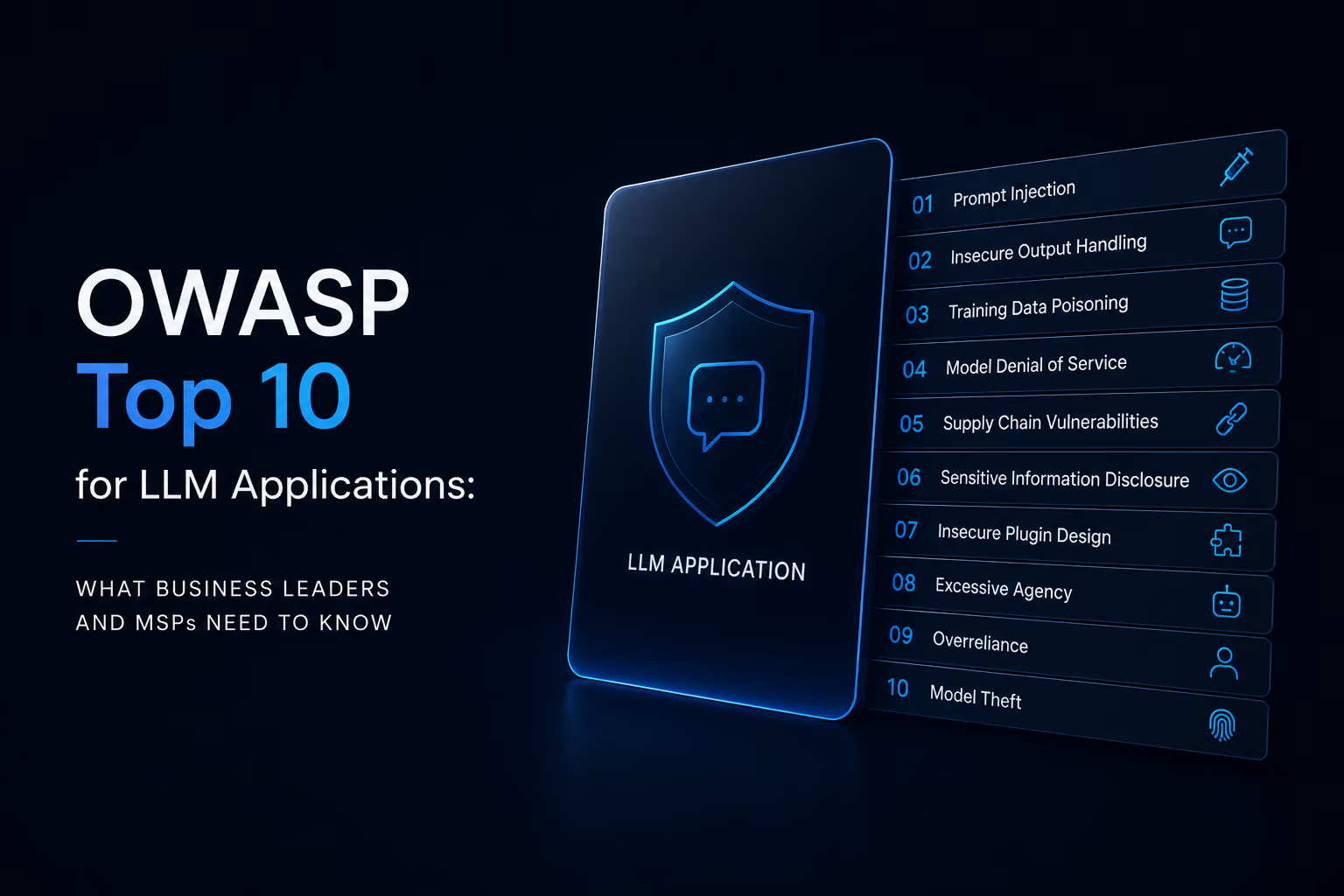
To help answer that question, the Open Worldwide Application Security Project (OWASP) developed the OWASP Top 10 for LLM Applications, a framework that highlights the most significant security risks organizations should understand when deploying AI-powered systems. While the framework was originally created for developers and security practitioners, its lessons extend far beyond technical teams. Business leaders, MSPs, and governance professionals can all benefit from understanding the risks shaping the future of AI security.
What is the OWASP top 10 for LLM applications?
OWASP is one of the most respected organizations in cybersecurity, known for publishing security guidance used by developers, security teams, and enterprises worldwide. The OWASP Top 10 for LLM Applications identifies the most critical security risks associated with Large Language Models and generative AI systems, helping organizations understand how AI changes traditional security assumptions and introduces entirely new attack surfaces.
Unlike traditional application security risks, many LLM-related risks involve user interactions, data exposure, AI-generated outputs, model behavior, and third-party integrations. This makes AI security a shared responsibility across technology, security, governance, and business teams.
Why business leaders should care about LLM security
Many executives assume AI security is primarily a technical problem. In reality, some of the biggest AI risks involve business decisions rather than software vulnerabilities — employees sharing sensitive information with AI systems, AI-generated misinformation influencing decisions, unauthorized AI adoption, compliance violations, and data governance failures.
The OWASP framework provides a useful way to think about these risks before they become incidents. Organizations don't need to become AI security experts overnight. They do need to understand where risk exists.
The most important OWASP LLM risks for businesses
While all ten categories are valuable, several are particularly relevant for SMBs and MSPs.
1. Prompt Injection Prompt injection is often described as one of the most significant AI-specific security risks. Instead of exploiting software vulnerabilities, attackers manipulate AI systems through carefully crafted instructions, aiming to override safeguards, influence outputs, trigger unintended actions, or access restricted information. Prompt injection demonstrates a fundamental reality of AI security: AI systems can be influenced through language, creating challenges traditional security controls were never designed to address.
Related Reading: → Real-World AI Security Incidents Every Business Leader Should Know
2. Sensitive Information Disclosure Data exposure remains one of the biggest concerns surrounding AI adoption. Organizations regularly process customer information, financial data, intellectual property, legal documents, and healthcare information. Without appropriate controls, sensitive information may be exposed through AI interactions, one reason AI governance and data governance are becoming increasingly interconnected.
Related Reading: → AI Data Leakage Explained
3. Insecure Output Handling Many organizations trust AI-generated outputs more than they should. AI can generate incorrect recommendations, misleading summaries, fabricated information, or biased content. The challenge is not that AI occasionally makes mistakes, it's that users may assume those outputs are accurate. Responsible organizations implement validation processes before acting on AI-generated recommendations.
4. Supply Chain and Third-Party Risks Most organizations do not build AI models from scratch. Instead, they rely on third-party AI platforms, embedded AI services, APIs, and AI integrations, creating supply chain considerations similar to those already seen in traditional software environments. Organizations should understand which AI providers they rely on, what data is being shared, how vendors handle information, and what governance controls exist. AI security is often only as strong as the weakest dependency.
5. Excessive Agency The next generation of AI systems is increasingly capable of taking action rather than simply generating content, AI agents, workflow automation, autonomous decision-making, and system integrations. These capabilities create significant productivity opportunities, but they also increase risk. Organizations must carefully manage permissions, approvals, and monitoring when AI systems are allowed to perform actions on behalf of users.
What OWASP teaches us about AI governance
One of the most important lessons from the OWASP framework is that AI security cannot be separated from AI governance. Many of the risks identified by OWASP are not purely technical, they involve user behavior, visibility, policy enforcement, data governance, and risk management. This means organizations need more than security tools; they need governance frameworks that help employees use AI responsibly.
Related Reading: → What Responsible AI Use Looks Like in a Modern Business
Why OWASP matters to MSPs
MSPs are increasingly being asked to guide customers through AI adoption. Many customers understand that AI introduces risk. Few understand where those risks exist. The OWASP framework provides MSPs with a useful foundation for conversations around AI security, governance, Shadow AI, risk assessments, policy development, and compliance.
Rather than focusing exclusively on technology, MSPs can use these concepts to help customers make informed decisions about AI adoption — positioning MSPs as strategic advisors rather than reactive support providers.
Related Reading: → AI Security for MSPs: The Next Evolution of Managed Security Services
Visibility remains the oundation
Although OWASP highlights multiple AI-specific risks, most organizations face a more immediate challenge: visibility. Before organizations can address prompt injection, data exposure, or governance concerns, they need to understand which AI tools are being used, who is using them, what information is being shared, and where risk exists.
Without visibility, governance becomes difficult. Without governance, risk grows over time. This is why visibility remains one of the most important building blocks of any AI security strategy.
Related Reading: → What Is AI Detection and Response (AIDR)?
.avif)
Conclusion
The OWASP Top 10 for LLM Applications provides an important reminder: AI security is not just about protecting systems. It's about understanding how AI changes the way information, users, and business processes interact. Organizations that understand these risks early will be better positioned to adopt AI safely and confidently.
The goal is not to avoid AI. The goal is to embrace AI with the visibility, governance, and controls necessary to reduce risk. As AI continues to evolve, frameworks like OWASP will play an increasingly important role in helping organizations navigate that journey.
.avif)
FAQs
Find answers to the most common questions about AI detection and response (AIDR), how it works, and why it matters for modern MSPs.