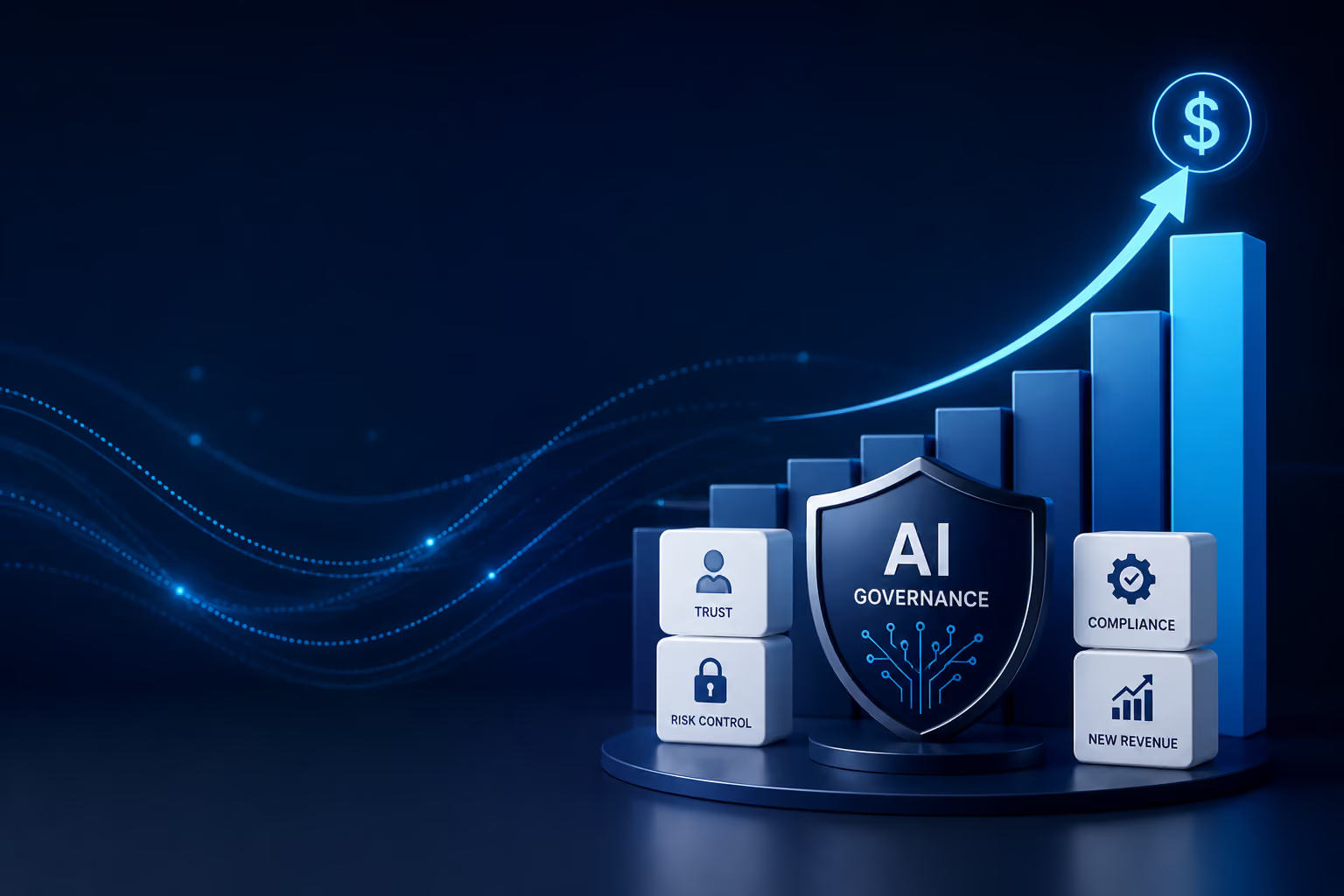

Most organizations don't have an AI problem. They have a visibility problem.
Over the last two decades, IT leaders have repeatedly faced the same challenge whenever transformative technology entered the workplace — first personal devices, then cloud storage, then SaaS applications. Employees adopted tools that helped them work faster, long before policies and security controls caught up. Today, the same pattern is playing out with artificial intelligence.
Employees are using ChatGPT to draft emails. Developers are using AI coding assistants. Marketing teams are generating content with AI-powered design platforms. Finance teams are leveraging AI to summarize reports and analyze data. The problem isn't that employees are using AI, it's that most organizations have little to no visibility into where AI is being used, what data is being shared, or whether that usage aligns with company policy.
This phenomenon is known as Shadow AI, and for many organizations, it has already become one of the most significant governance and security challenges of the AI era.
Understanding the Bigger AI Security Picture Shadow AI is only one piece of the broader AI security challenge. As AI adoption accelerates, organizations must also address AI-specific threats, compliance concerns, data exposure risks, and governance requirements. → Read: The Complete Guide to AI Security for SMBs
What is shadow AI?
Shadow AI refers to the use of artificial intelligence tools, applications, models, or services without formal approval, visibility, or governance from an organization's IT or security team. In simple terms, it's AI that exists outside official oversight.
Examples include employees using ChatGPT with personal accounts, teams uploading business documents to public AI tools, developers using unauthorized AI coding assistants, AI-powered browser extensions and note-taking apps, embedded AI features within SaaS platforms, and AI agents connected to business workflows.
In many cases, employees aren't intentionally bypassing security controls, they're simply trying to work faster. That's what makes Shadow AI both understandable and dangerous.
Why shadow AI is different from shadow IT
Many cybersecurity professionals compare Shadow AI to Shadow IT, and while the comparison is useful, Shadow AI introduces risks that go far beyond unauthorized software usage. Traditional Shadow IT involved unsanctioned cloud storage, unauthorized SaaS applications, and personal devices accessing business data.
Shadow AI introduces a completely different dynamic. AI doesn't simply store information — it processes it, analyzes it, generates content from it, may retain it, may share it across workflows, and may influence business decisions based on it. The moment an employee submits information to an AI system, the organization's data governance model changes. That makes Shadow AI fundamentally different from previous technology adoption challenges.
Why employees use shadow AI
Most employees are not trying to create risk, they're trying to solve problems. AI tools deliver immediate value: faster content creation, improved research, better productivity, simplified coding, faster customer communication, and workflow automation. When employees discover a tool that saves hours each week, adoption happens quickly.
The challenge is that organizational governance moves much more slowly. Policies require reviews. Security teams need assessments. Compliance teams need validation. Employees simply need a login. The result is predictable: AI adoption often happens months before organizations realize it, one reason AI adoption is accelerating faster than any previous technology shift.
Related Reading: → The Rise of AI in SMBs: Why Security Must Evolve Faster Than Adoption
The hidden risks of shadow AI
The conversation around Shadow AI often focuses on productivity. Security leaders see something else: risk. Not because AI is inherently dangerous, but because invisible technology creates invisible risk.
1. Sensitive Data Exposure This is the concern most security teams encounter first. Employees routinely submit information to AI systems without fully understanding how it's stored, how long it's retained, whether prompts are logged, whether it's used for training, or which jurisdictions process the data. Examples include customer information, financial records, legal contracts, intellectual property, source code, and product roadmaps. The issue isn't malicious intent — it's a lack of visibility and control.
Related Reading: → AI Data Leakage Explained
2. Compliance and Regulatory Risk Organizations operating in regulated industries face additional challenges. If employees unknowingly share regulated information with AI platforms, organizations may create exposure under HIPAA, PCI-DSS, GDPR, SOC 2, or financial regulations. Many compliance frameworks were developed before widespread AI adoption, and security leaders must now interpret how those requirements apply in an AI-driven environment.
Related Reading: → AI Compliance Risks: What SMBs Need to Know
3. Intellectual Property Leakage One of the most overlooked Shadow AI risks involves intellectual property. Organizations invest years building proprietary processes, product designs, source code, customer insights, and competitive strategies. Without governance controls, employees may unknowingly expose these assets through AI interactions. For many businesses, intellectual property is their most valuable asset — yet it's often the easiest information to accidentally share.
4. Loss of Organizational Visibility The greatest AI security challenge isn't necessarily data exposure — it's visibility. Many organizations cannot answer basic questions such as which AI tools are being used, how many employees are using them, what data is being shared, which departments use AI most frequently, or whether AI policies are being followed. You cannot govern what you cannot see, and you cannot secure what you cannot govern.
Why banning AI doesn't work
When organizations discover Shadow AI, the first instinct is often to block it. Unfortunately, history shows this approach rarely succeeds. Organizations tried banning cloud storage, smartphones, remote work tools, and SaaS applications, employees found alternatives every time. AI follows the same pattern.
Modern business applications increasingly include AI functionality by default. Blocking ChatGPT does not eliminate AI usage; it simply reduces visibility. The objective should not be to prevent AI adoption, it should be to make AI adoption safe.
Related Reading: → Why Blocking AI Doesn't Work: A Better Approach to AI Governance
Why shadow AI matters to MSPs
Shadow AI is not just an organizational challenge — it is increasingly becoming an MSP challenge. As businesses adopt AI tools without formal oversight, many MSPs are discovering that customers expect them to provide guidance around AI governance, security, and compliance.
The difficulty is that most MSPs cannot manage what they cannot see. If an employee uses ChatGPT on a personal account, installs an AI browser extension, or interacts with embedded AI features inside SaaS applications, traditional monitoring tools may provide little visibility into that activity. This creates several challenges for MSPs:
- Increased Security Risk — AI introduces new attack surfaces, including prompt injection, unauthorized data sharing, and AI-assisted fraud.
- Compliance Exposure — Customers may unknowingly expose regulated or confidential information to AI systems.
- Governance Expectations — Many SMBs now expect their MSP to help define acceptable AI use policies and best practices.
- New Service Opportunities — Forward-thinking MSPs are beginning to offer AI risk assessments, governance reviews, Shadow AI discovery services, policy development, and AI security monitoring.
For MSPs, Shadow AI represents both a growing security concern and a significant business opportunity. Organizations need trusted advisors to help them navigate AI adoption safely, and MSPs are uniquely positioned to fill that role.
Related Reading: → The MSP Guide to AI Security and Governance Services
Building a shadow AI governance framework
Effective AI governance begins with visibility. Before organizations can write policies or enforce controls, they need to understand where AI already exists. A practical framework includes:
- Visibility — Identify AI tools, platforms, and services being used across the organization.
- Risk Assessment — Understand what data is being shared and where risk exists.
- Policy Development — Create clear guidance for acceptable AI usage.
- Guardrails — Implement controls that follow users and data rather than individual applications.
- Continuous Monitoring — AI adoption evolves quickly, and governance must evolve with it.
Organizations that treat AI governance as an ongoing process, not a one-time project, are far more likely to succeed.
Related Reading: → What Responsible AI Use Looks Like in a Modern Business
Conclusion
Most organizations don't have an AI problem. They have a visibility problem. AI adoption is happening whether leadership approves it or not, employees are discovering new tools, experimenting with new workflows, and integrating AI into daily operations at a pace few organizations can match.
The greatest risk isn't AI itself. It's allowing AI adoption to happen without visibility, governance, or security controls. Organizations that gain visibility today will be better positioned to govern AI tomorrow. Those that wait may discover Shadow AI has already become part of their business infrastructure.
FAQs
Find answers to the most common questions about AI detection and response (AIDR), how it works, and why it matters for modern MSPs.