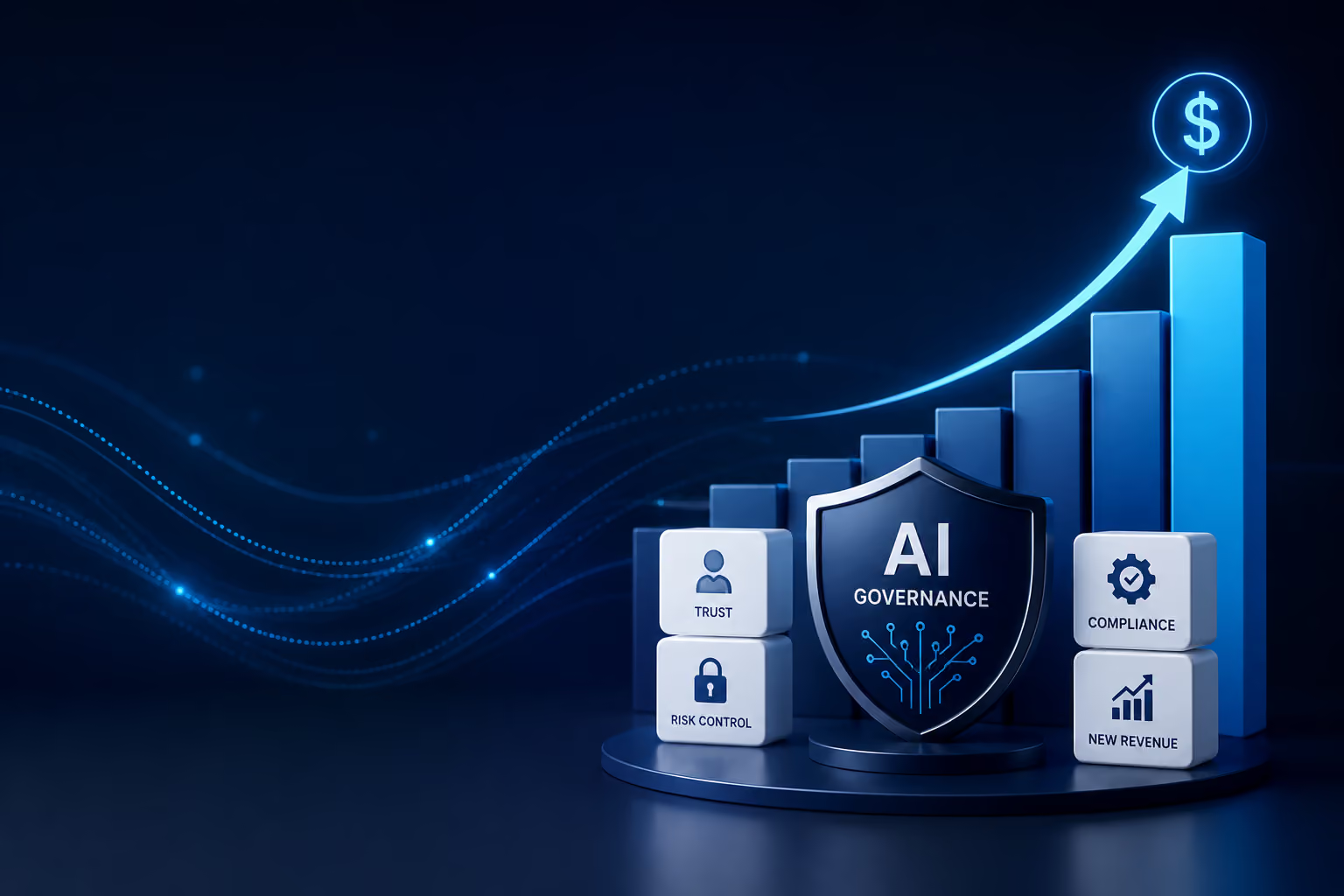

Artificial Intelligence has become the fastest-adopted technology in modern business history. From content creation and customer service to software development and business analytics, AI is helping organizations move faster, improve productivity, and unlock efficiencies that were previously out of reach.
For small and medium-sized businesses (SMBs), AI represents a major competitive advantage. Teams can automate repetitive work, accelerate decision-making, improve customer experiences, and access capabilities that once required enterprise-sized budgets.
But while AI adoption is accelerating rapidly, security and governance efforts are struggling to keep pace. The challenge isn't AI itself, it's uncontrolled AI adoption. Organizations across every industry are discovering that employees are already using AI tools, often without visibility, oversight, or security controls. This creates a new category of risk that traditional cybersecurity programs were never designed to address.
New to AI Security? AI adoption is accelerating faster than most organizations can govern it. If you're looking for a complete framework covering AI governance, Shadow AI, compliance, AI-specific threats, and security best practices, read our guide: [The Complete Guide to AI Security for SMBs →]
AI is already inside your organization
Many business leaders assume AI adoption occurs through formal IT projects. In reality, AI often enters organizations through individual employees looking for faster, more efficient ways to work, marketing teams generating content, sales teams drafting outreach, developers using AI coding assistants, executives summarizing reports, and customer service teams relying on AI-powered chat tools.
The result is that AI becomes embedded into daily business operations long before governance frameworks are established. This phenomenon is commonly known as Shadow AI, the use of AI tools without organizational visibility, approval, or oversight. Unlike traditional shadow IT, Shadow AI introduces additional risk because employees frequently share information directly with AI systems without fully understanding how that information is processed, stored, or reused.
Organizations cannot govern what they cannot see.
Related Reading: → Shadow AI: The Hidden Threat Already Inside Your Organization
AI is no longer just ChatGPT
When most people think about AI, they think of ChatGPT, Claude, or Google Gemini. But AI has evolved far beyond standalone applications and now exists across nearly every layer of the modern business technology stack.
Explicit Generative AI — Tools employees intentionally use, including ChatGPT, Claude, Google Gemini, and Perplexity.
Embedded AI — AI capabilities increasingly built directly into everyday business applications like Microsoft 365, Slack, Grammarly, Notion, and Salesforce. Many employees may not even realize they're interacting with AI when using these tools.
Creative and Content AI — Marketing and design teams rapidly adopting Canva AI, Adobe Firefly, AI presentation builders, and image generation platforms.
Developer and Technical AI — Technical teams using AI to assist with coding, troubleshooting, configuration management, and documentation.
AI Infrastructure and APIs — Many organizations unknowingly leverage AI through APIs, automation platforms, browser extensions, and third-party integrations operating behind the scenes.
As AI becomes infrastructure rather than a destination, visibility becomes increasingly difficult. Organizations need to understand not just where AI is being used, but what data is being shared and how those systems interact with business information.
Related Reading: → Four AI Risks Every SMB Should Understand Before Deploying AI
Why traditional security models are struggling
Most cybersecurity programs were built around known threats, malware, exploits, suspicious URLs, malicious executables, network intrusions. AI introduces a completely different category of risk. The danger often isn't malicious software; it's how data is interpreted, shared, processed, and acted upon by AI systems.
Employees may paste confidential data into AI tools. AI systems may generate inaccurate business recommendations. Autonomous AI agents may take actions across connected systems. AI-powered workflows may expose sensitive information unintentionally.
These risks are contextual, behavioral, and constantly evolving. Legacy security tools were never designed to monitor prompts, understand intent, or evaluate how AI interacts with sensitive business information, which is why organizations need new approaches to AI visibility, governance, and control.
Related Reading: → Why Traditional Cybersecurity Tools Can't Protect Against AI Threats
A new generation of AI threats is emerging
AI-related incidents are no longer hypothetical. Organizations worldwide are already encountering attacks specifically designed to exploit AI systems and workflows:
- Prompt Injection Attacks — Attackers manipulate AI behavior through carefully crafted instructions designed to bypass safeguards or expose sensitive information.
- AI Data Leakage — Sensitive information can be exposed through AI-powered features embedded in productivity tools, even when users take no direct action.
- AI Platform Abuse — Unauthorized access to AI platforms can result in unexpected operational costs, resource consumption, and financial losses.
- AI Workflow Takeovers — Compromised AI workflows can amplify the impact of a single action across multiple applications and systems.
These incidents highlight a critical reality: AI introduces entirely new attack surfaces that traditional security solutions were never built to detect.
Related Reading: → Real-World AI Security Incidents Every Business Leader Should Know
The four major AI risks facing SMBs
Organizations adopting AI should focus on four key categories of risk.
1. Data Exposure and Compliance Risk Employees frequently share information with AI systems without understanding how it's stored, whether it's retained, if it's reused for model training, or where it's processed geographically, creating significant compliance and regulatory concerns.
2. Unsafe or Non-Compliant AI Content AI-generated content can include hallucinations, biases, inaccurate recommendations, or non-compliant language. Organizations cannot assume AI output is automatically trustworthy.
3. AI-Specific Security Attacks Prompt injection, agent manipulation, AI-assisted fraud, and unauthorized AI access are new threats that require entirely new detection strategies.
4. Shadow AI Perhaps the greatest challenge is visibility. Most organizations cannot answer which AI tools employees use, what information is being shared, whether usage aligns with company policy, or how frequently AI is accessed. You cannot secure what you cannot see.
Why AI security matters to MSPs
For Managed Service Providers (MSPs), AI adoption is creating an entirely new service category. Historically, MSPs have helped customers navigate major technology shifts, cloud migration, remote work, SaaS adoption, cybersecurity modernization. AI is following a similar path, but at a much faster pace.
The challenge is that most SMB customers are adopting AI before they establish governance policies, security controls, or compliance frameworks. Employees experiment with AI tools independently, while embedded AI capabilities quietly appear inside business applications. As a result, many organizations are turning to their MSPs for guidance, asking which AI tools are being used, whether sensitive data is being shared, how usage can be monitored and governed, what compliance risks AI introduces, and how policies should be enforced.
This creates both a challenge and an opportunity. MSPs that can provide AI visibility, governance, and security services will be better positioned to become strategic advisors rather than traditional technology support providers. As AI adoption continues to accelerate, AI detection, governance, and risk management are likely to become core components of the modern managed security stack.
Related Reading: → The MSP Guide to AI Security and Governance Services
What responsible AI adoption looks like
The solution is not banning AI. Blocking AI entirely is unrealistic because AI capabilities are increasingly embedded within trusted business applications. Instead, organizations should focus on responsible AI adoption, built on five principles:
- Visibility — Understand where AI is being used.
- Control — Define what data can and cannot be shared.
- Protection — Detect and mitigate AI-specific threats.
- Policy Enforcement — Ensure AI usage aligns with organizational requirements.
- User Enablement — Help employees use AI safely without reducing productivity.
Organizations that embrace these principles can accelerate innovation while reducing risk.
Related Reading: → What Responsible AI Use Looks Like in a Modern Business
Conclusion
Artificial Intelligence is transforming how SMBs operate, compete, and grow. But while AI adoption creates enormous opportunities, it also introduces challenges that many organizations aren't prepared to manage. The rise of Shadow AI, AI-specific attacks, compliance concerns, and data exposure risk means businesses can no longer rely solely on traditional cybersecurity approaches.
Organizations need visibility into AI activity, control over how data is shared, and Guardrails that help employees use AI safely. Those that establish these foundations today will be better positioned to innovate confidently tomorrow.
.avif)
FAQs
Find answers to the most common questions about AI detection and response (AIDR), how it works, and why it matters for modern MSPs.