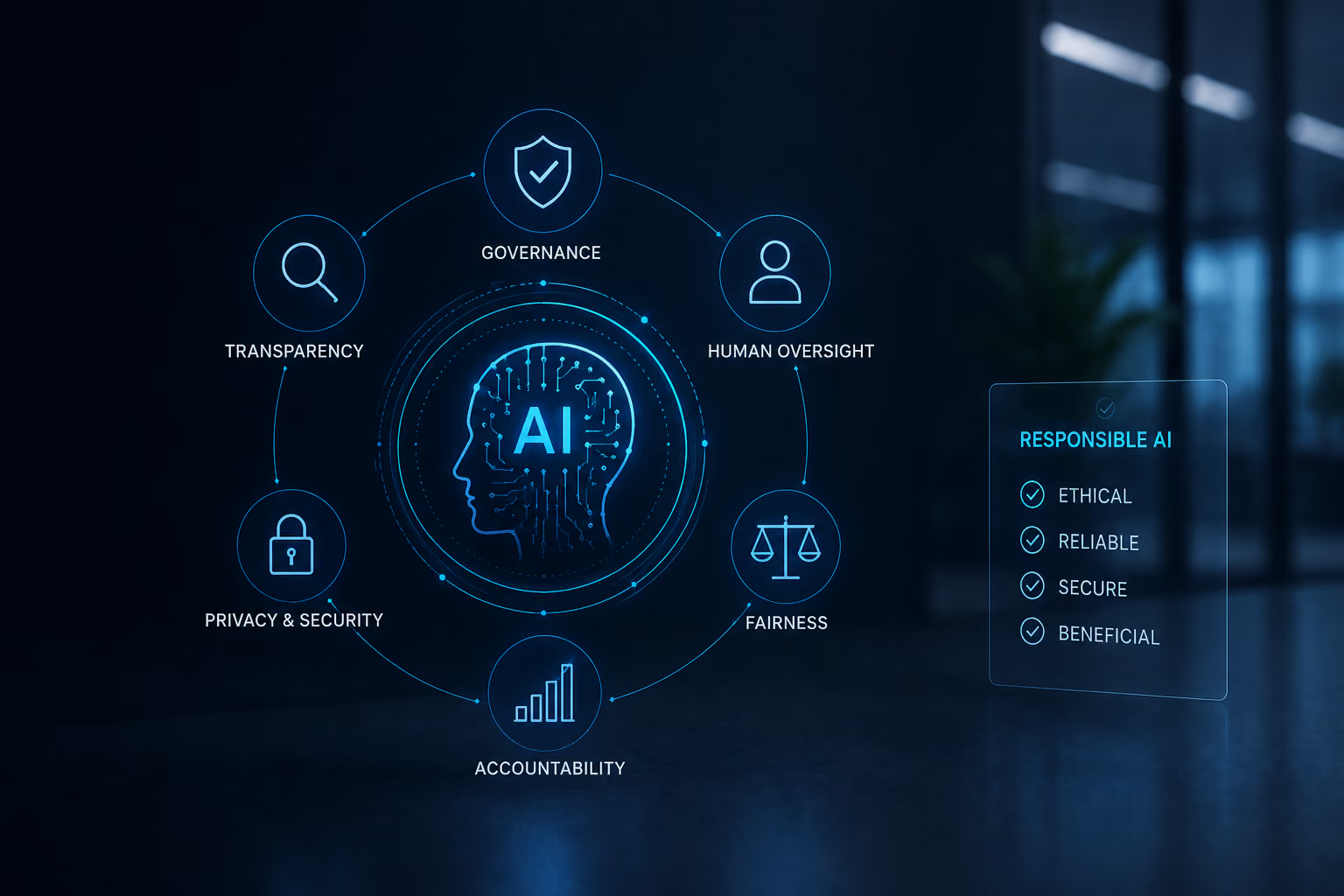

Most conversations about artificial intelligence tend to fall into one of two extremes. On one side are the enthusiasts who believe AI should be adopted as quickly as possible. On the other are the skeptics who focus entirely on risk. Neither perspective is particularly helpful.
The reality is that AI is neither inherently good nor inherently dangerous. Like every major technology shift before it, its impact depends largely on how organizations choose to implement and govern it. The organizations seeing the greatest value from AI today are not necessarily the ones adopting it the fastest, they're the ones adopting it responsibly.
Responsible AI is not about slowing innovation. It's about creating the visibility, governance, and controls needed to ensure AI can be used safely, ethically, and effectively. For business leaders, security teams, and MSPs, that distinction matters. The goal is not to stop AI adoption, it's to make AI adoption sustainable.
Responsible AI starts with a mindset shift
One of the biggest mistakes organizations make is treating AI as a technology problem. In reality, AI is a business problem, a governance problem, and a people problem, technology is only one piece of the equation. Responsible AI requires organizations to think differently about data, risk, governance, user behavior, decision-making, and compliance.
This is why organizations often struggle when they approach AI solely through the lens of cybersecurity. Security remains critical, but responsible AI extends beyond security controls, it requires a framework that balances innovation with accountability.
Why responsible AI matters more than ever
The pace of AI adoption has created a governance gap in many organizations. Employees are using AI tools before policies exist. Departments are experimenting with AI before risks are understood. Applications are introducing embedded AI capabilities faster than security teams can evaluate them.
As a result, organizations face challenges such as Shadow AI, data leakage, compliance concerns, AI-generated misinformation, AI-specific security risks, and a general lack of visibility. These challenges are not signs that AI adoption should stop, they're signs that governance needs to catch up. Organizations that address governance early are far more likely to realize the benefits of AI without creating unnecessary risk.
Related Reading: → Why Blocking AI Doesn't Work: A Better Approach to AI Governance
The five pillars of responsible AI
Although every organization has unique requirements, successful AI programs tend to share several common characteristics that form the foundation of responsible AI adoption.
1. Visibility: You Cannot Govern What You Cannot See Most organizations underestimate how much AI activity already exists within their environment, employees use AI tools independently, business applications contain embedded AI features, and developers integrate AI assistants into workflows. Without visibility, organizations cannot answer fundamental questions such as which AI tools are being used, who is using them, what information is being shared, and which departments have adopted AI. Visibility is the starting point for every AI governance initiative; without it, every other control becomes significantly more difficult.
Related Reading: → Shadow AI: The Hidden Threat Already Inside Your Organization
2. Governance: Define Acceptable AI Use Responsible AI requires clear expectations. Organizations should establish guidance around approved AI use cases, restricted information types, data handling requirements, compliance obligations, and user responsibilities. Importantly, governance shouldn't focus exclusively on restricting technology, the most effective governance frameworks enable productivity while reducing risk. Employees should understand not only what they cannot do, but how they can use AI safely and effectively. Governance works best when it creates clarity rather than confusion.
3. Data Protection: Focus on What Matters Most Many AI-related incidents involve information rather than infrastructure, which is why data protection remains central to responsible AI. Organizations should identify which categories of information require additional protection, customer information, financial records, healthcare data, intellectual property, legal documents, and confidential business information. The goal is not to prevent AI usage; it's to ensure sensitive information is handled appropriately. As AI adoption grows, data governance and AI governance become increasingly interconnected.
Related Reading: → AI Data Leakage Explained
4. Risk Management: Anticipate New Threats Every emerging technology introduces new forms of risk, and AI is no exception. Organizations should evaluate risks involving prompt injection attacks, AI-assisted fraud, Shadow AI, AI-generated misinformation, compliance exposure, and autonomous AI workflows. Responsible organizations recognize that AI risk management is not a one-time exercise, the threat landscape will continue to evolve, and governance frameworks must evolve alongside it.
Related Reading: → Four AI Risks Every SMB Should Understand Before Deploying AI
5. Education: Empower People to Use AI Responsibly Technology controls are important, but education is equally important. Most AI-related security incidents don't occur because employees are malicious, they occur because employees lack context. Organizations should provide practical guidance on acceptable AI usage, sensitive information handling, common AI risks, compliance considerations, and responsible decision-making. Employees who understand the risks are far more likely to make informed decisions. Responsible AI is ultimately a shared responsibility.
What responsible AI does not mean
There are several misconceptions about responsible AI. It does not mean eliminating AI — organizations that attempt to avoid AI entirely often fall behind competitors that adopt it responsibly. It doesn't mean blocking every AI tool, history shows that restrictive technology policies frequently create Shadow AI. It doesn't mean slowing innovation, responsible AI should accelerate innovation by creating trust and confidence. And it doesn't mean treating AI as a pure security problem, AI affects operations, compliance, governance, risk management, and business strategy, not just cybersecurity.
Understanding what responsible AI is not can be just as important as understanding what it is.
Why this matters to MSPs
Responsible AI is quickly becoming a business advisory opportunity for MSPs. Many SMBs want to adopt AI but lack the internal expertise required to develop governance frameworks, evaluate risks, and establish policies. As a result, organizations are increasingly turning to MSPs for guidance, asking how they should govern AI, what policies they should create, how to identify Shadow AI, what information employees can safely share, and how to monitor AI usage.
Forward-thinking MSPs are responding by expanding their services to include AI governance consulting, readiness assessments, Shadow AI discovery, policy development, risk assessments, and ongoing monitoring. This positions MSPs as strategic advisors rather than simply technology providers, and as AI adoption accelerates, responsible AI governance will become an increasingly valuable service offering.
Related Reading: → The MSP Guide to AI Security and Governance Services
.avif)
Conclusion
Responsible AI is not about choosing between innovation and security. It's about creating a framework that enables both. Organizations that approach AI with visibility, governance, data protection, risk management, and education are far more likely to achieve sustainable success.
The future belongs to organizations that can adopt AI confidently, not recklessly. By building responsible AI practices today, organizations can unlock the benefits of AI while maintaining the trust, security, and accountability that long-term success requires.
.avif)
FAQs
Find answers to the most common questions about AI detection and response (AIDR), how it works, and why it matters for modern MSPs.