
The MSP business has always evolved alongside the technology its customers adopt. From infrastructure and cloud management to cybersecurity, service providers have continually expanded their role to help businesses operate securely as their technology environments become more complex.
AI is creating the next shift for both MSPs, and the customers they manage.
Customers are adopting AI faster than they are putting the right controls in place. Employees are using AI assistants, developers are working with coding agents, and AI capabilities are becoming embedded in everyday business applications. Increasingly, AI agents can also interact with company data, applications and systems.
For MSPs, this creates a visibility and governance problem. Which AI applications are customers using? What information is being shared? Which agents have access to business systems? And are existing security policies equipped to manage these interactions?
Traditional IT and cybersecurity services do not automatically answer these questions. MSPs need a way to discover AI usage, assess exposure, establish guardrails and continuously monitor activity across customer environments.
This makes AI governance an emerging extension of the managed services portfolio. But delivering it requires more than an acceptable-use policy or a one-time AI assessment. It requires the right technology to make discovery, governance and ongoing security operationally manageable.
An AI governance platform for MSPs should provide that foundation. This guide explores the capabilities to evaluate, the platforms available and how MSPs can turn AI governance into a repeatable managed service.
What Is an AI Governance Platform?
An AI governance platform is software that helps organizations discover, assess, manage and monitor their use of artificial intelligence. It provides visibility into AI systems and applications, supports policies and risk assessments, and helps organizations establish accountability for how AI is used.
AI governance extends beyond approving or blocking individual applications. It involves understanding the full AI environment, defining acceptable usage, managing risks and maintaining oversight as adoption changes.
A comprehensive AI governance program addresses five questions:
- What AI is being used? Identify AI applications, models, agents and AI-powered services across the organization.
- Who is using it? Understand which employees, departments and devices interact with AI.
- What can it access? Evaluate the data, applications, systems and tools available to AI applications and agents.
- How should it be used? Establish policies, permissions, acceptable-use requirements and governance processes.
- How is it monitored? Identify policy violations, investigate risky activity and maintain ongoing oversight.
An AI governance platform brings some or all of these activities into a structured operating environment.
The exact capabilities vary by vendor. Some platforms primarily manage AI inventories, model risk assessments and compliance documentation. Others provide technical controls for AI applications, prompts, data exposure and agent activity.
For MSPs, understanding this distinction is essential when selecting a platform.
AI Governance vs. AI Security vs. AI Detection & Response
These terms are related, but they describe different responsibilities. Understanding the distinction helps MSPs build the right service offering.
Consider an employee at a law firm using an AI assistant or AI agent, for example Codex to analyze a customer contract.
AI governance determines whether the employee is permitted to use the application and what information may be shared.
AI security focuses on protecting the information and controlling the risks associated with that interaction.
And most importantly, AIDR provides ongoing monitoring to identify risky activity, investigate policy violations and support an appropriate response.
Every one of these disciplines work together. Governance establishes expectations, security implements protections, and detection and response provide continuous oversight.
For MSPs, this creates an opportunity to extend existing cybersecurity and compliance services into AI governance and AIDR.
Types of AI Risks that MSPs need to govern
One of the biggest mistakes organizations make is treating AI adoption as a chatbot problem.
Employees may use ChatGPT or Claude directly, but AI capabilities are also embedded in business applications, development environments, productivity tools and autonomous agents. There is also the risk of hidden attacks from prompt injection, personal AI platform usage and more.
An MSP needs to understand the different layers of this environment.
General-purpose AI assistants
These are applications employees use directly to generate content, summarize information, analyze documents, research topics and complete everyday tasks.
Examples include:
- OpenAI ChatGPT
- Anthropic Claude
- Google Gemini
- Microsoft Copilot
- Perplexity
The governance questions include whether employees use personal or business accounts, what information they submit, which versions or services are approved, and whether sensitive data is exposed.
AI embedded in business applications
AI functionality is increasingly built into software organizations already use.
Examples include Salesforce Einstein, Notion AI, Zoom AI Companion, Adobe Firefly and Microsoft 365 Copilot.
This creates a visibility challenge. An organization may approve a SaaS application without having a separate process for reviewing every AI capability introduced through it.
MSPs should therefore look beyond standalone AI tools and consider AI features embedded in the wider software environment.
AI coding assistants
Development teams are adopting tools such as GitHub Copilot, Cursor, Claude Code and OpenAI Codex.
These tools introduce additional considerations because they may interact with source code, repositories, local files, terminals and development workflows.
The important question is not simply which coding assistant is installed. It is what information and resources the assistant can access, and what actions it is permitted to perform.
AI agents and connected tools
AI agents introduce another layer of complexity.
Unlike a conventional chatbot that primarily responds to prompts, an AI agent can be configured to perform tasks using external tools and connected systems. Depending on its permissions, it may retrieve information, interact with applications, modify files or initiate workflows.
The Model Context Protocol (MCP) is one mechanism through which AI applications can connect to external tools and data sources.
For example, an AI agent might connect to GitHub, Google Drive, Slack, a CRM or an internal database through MCP servers.
This creates an access chain:
User → AI Agent → MCP Server → Tool → Data or Business System
Discovering the agent is only the first step. MSPs also need to understand which users can invoke it, what tools it can reach, what permissions those tools have and what actions they enable.
This is why AI agent discovery and access visibility are becoming important components of AI governance.
Why Traditional Security Tools Leave AI Governance Gaps
Traditional cybersecurity tools remain essential. Endpoint detection and response, identity management, network security, email security and data loss prevention all contribute to an organization's security posture.
However, AI introduces interactions that are not always adequately represented by conventional security monitoring.
Consider three scenarios.
Scenario 1: An employee shares sensitive information with an AI assistant.
An employee pastes customer information into an external AI application to summarize a document. The endpoint may be protected and the application may be accessible over an approved network connection, but the interaction can still create a data exposure risk.
Scenario 2: An employee adopts an unapproved AI application.
A team starts using an AI-powered browser extension or a new productivity application without informing IT. The organization may have no formal record of the application or its usage.
Scenario 3: An AI agent has access to business systems.
A developer configures an AI agent with access to source code, files or external tools. The agent may have permissions that extend beyond what the organization intended.
These scenarios require visibility into AI applications, user activity, data interactions, policies and agent access relationships.
A traditional security stack may provide some relevant signals, but MSPs should evaluate whether it can answer these AI-specific questions directly.
What Should MSPs Look for in an AI Governance Platform?
Selecting an AI governance platform requires more than comparing feature lists. MSPs need to understand whether the software can support the technical, operational and commercial requirements of managing AI across multiple customer environments.
The following capabilities form a practical evaluation framework.
1. AI application discovery and Shadow AI visibility
An organization cannot govern AI applications it does not know exist.
The platform should help identify AI applications being used across monitored environments, including commonly adopted assistants and less obvious AI-powered services.
Look for the ability to:
- Discover recognized AI applications.
- Identify unsanctioned or previously unknown AI usage.
- Track adoption across users and devices.
- Distinguish applications and services where possible.
- Maintain visibility as new tools enter the environment.
Shadow AI discovery is particularly important for MSPs because customers often underestimate how widely AI is already being used.
A useful assessment should show more than an application count. It should help answer who is using the tools, where adoption is occurring and which applications need further review.
2. User, device and activity context
An inventory of AI applications provides a starting point, but it does not explain how those applications are being used.
MSPs should look for user and device context that helps connect AI activity to a specific customer environment.
Useful information may include:
- User identity and email.
- Device information.
- Application name.
- Activity and timestamp.
- Action or event details.
- Relevant prompt, file or policy information, where supported.
This context makes investigations more useful. Instead of reporting that an AI application was detected, an MSP can investigate which user interacted with it, from which device and what activity requires attention.
3. Prompt and data inspection
One of the most important AI security concerns is sensitive information being shared with AI applications.
A governance platform should be evaluated on its ability to inspect AI interactions and identify potentially sensitive information.
Depending on the product, this may include detecting sensitive data in prompts or file uploads, identifying policy-triggering activity, and supporting actions such as logging, blocking or redacting information.
MSPs should ask vendors:
- Can the platform inspect prompts and responses?
- Which types of sensitive information can it identify?
- Can policies be applied to specific data categories?
- Can sensitive information be redacted or blocked?
- Is activity recorded for later investigation?
- What happens when a policy is triggered?
Do not assume every platform offering AI governance includes prompt-level inspection. Some focus primarily on policies, risk assessments and compliance workflows.
4. AI policies and enforcement
Governance requires more than discovering risks. Organizations need rules that define acceptable AI usage.
A platform should help MSPs implement policies covering areas such as:
- Approved and restricted AI applications.
- Sensitive data handling.
- Acceptable-use requirements.
- Employee access and usage expectations.
- Data protection guardrails.
- Policy exceptions and review processes.
It is also important to distinguish between policy documentation and technical enforcement.
A policy document may tell employees not to share confidential information with public AI tools. A technical control can help identify or prevent specific interactions that violate that policy.
MSPs should evaluate whether a platform supports configurable controls, such as allowing, blocking or logging activity, and whether enforcement can be tailored to different customer requirements.
5. AI agent and MCP discovery
This is becoming an increasingly important evaluation criterion.
As organizations adopt AI agents, MSPs need visibility into more than the applications employees launch.
A platform should be evaluated on its ability to discover AI agents, identify associated users and devices, and map their relationships with MCP servers and connected tools.
The key questions are:
- Which AI agents are present?
- Which users or devices are associated with them?
- Which MCP servers do they connect to?
- Which tools are available through those connections?
- What permissions do those tools have?
- Could an agent access sensitive systems or perform actions that create business risk?
A useful AI agent governance capability should help MSPs understand the potential blast radius of an agent's access.
For example, discovering an AI coding agent is useful. Understanding that it can interact with repositories, files and external services is much more valuable from a security perspective.
6. Risk investigation and response
Discovery and policy management need to be supported by an ongoing process for investigating risky activity.
Evaluate whether the platform can identify policy violations, unauthorized AI usage and sensitive data exposure, and whether it provides enough context for the MSP to investigate.
Look for:
- Alerts for relevant policy violations.
- Activity history and investigation context.
- Visibility into users, devices and applications involved.
- Support for blocking or remediation where available.
- Reporting on recurring risks and policy trends.
The objective is to move from a one-time AI assessment to continuous AI security oversight.
7. Reporting and governance evidence
MSPs need to communicate AI risk to two different audiences.
Technical teams need actionable information about applications, users, devices, policy violations and investigations.
Business leaders need a clearer view of AI adoption, exposure, governance progress and recommended actions.
A useful platform should support both.
Look for executive dashboards, AI exposure reports, usage summaries, policy violation reporting and information that can support governance reviews.
Where regulatory or audit requirements apply, also evaluate how the platform records evidence and whether that evidence is sufficient for the customer's specific obligations.
8. Multi-tenant architecture and MSP operations
This is a fundamental requirement for an MSP-specific platform.
An enterprise tool designed for one organization may not translate well into a managed service model.
MSPs should evaluate whether the platform supports:
- Multiple customer environments.
- Separation of customer data and administration.
- Centralized visibility across accounts.
- Customer-specific policies and configurations.
- Efficient onboarding and deployment.
- Reporting at both customer and portfolio levels.
- Role-based access for MSP teams.
The objective is to manage AI security across customers without creating a separate, resource-intensive operating process for every account.
9. Commercial viability
Finally, evaluate whether the platform makes financial sense for the MSP.
Consider licensing structure, per-user or per-device pricing, deployment effort, support requirements, operational overhead and the ability to package services around the platform.
A technically capable platform may still be difficult to commercialize if its pricing model does not support the MSP's service margins.
The right platform should help the MSP deliver a repeatable service, not simply add another tool to its internal stack.
How MSPs Can Operationalize AI Governance Across Customers
Once an MSP selects a platform, the next challenge is turning its capabilities into a repeatable service.
A practical operating model can follow five stages.
Stage 1: Discover AI usage
Begin with an AI visibility assessment.
Identify AI applications, agents and Shadow AI activity across the customer's monitored environment. Establish which users and devices are involved and identify areas requiring further investigation.
The deliverable should be an AI usage inventory and an initial view of potential exposure.
Stage 2: Assess exposure
Use the discovery findings to understand where risks may exist.
Review sensitive data exposure, unapproved applications, AI agent access, existing policies and governance gaps.
Present the findings in business terms. A customer needs to understand what has been discovered, why it matters and what should happen next.
Stage 3: Establish governance controls
Work with customer stakeholders to define acceptable AI usage.
Create or update AI acceptable-use policies, establish approved application lists, define data handling requirements and implement technical guardrails where supported.
The goal is not necessarily to block AI adoption. It is to make adoption more visible, controlled and aligned with business requirements.
Stage 4: Monitor and respond
AI adoption changes continuously. New applications, features and agents can appear, while existing tools gain new capabilities.
Introduce ongoing monitoring, policy violation reviews, investigation processes and remediation workflows.
This is where AI Detection & Response becomes a recurring component of the managed service.
Stage 5: Report and review
Provide regular reporting to customer stakeholders.
A governance review can cover:
- New AI applications and agents discovered.
- Changes in AI adoption.
- Sensitive data and policy violations.
- Emerging agent and MCP exposure.
- Governance controls implemented.
- Outstanding risks and recommended actions.
This creates a continuous improvement process rather than treating AI governance as a one-time audit.
How Kipling Secure Helps MSPs Deliver AI Governance
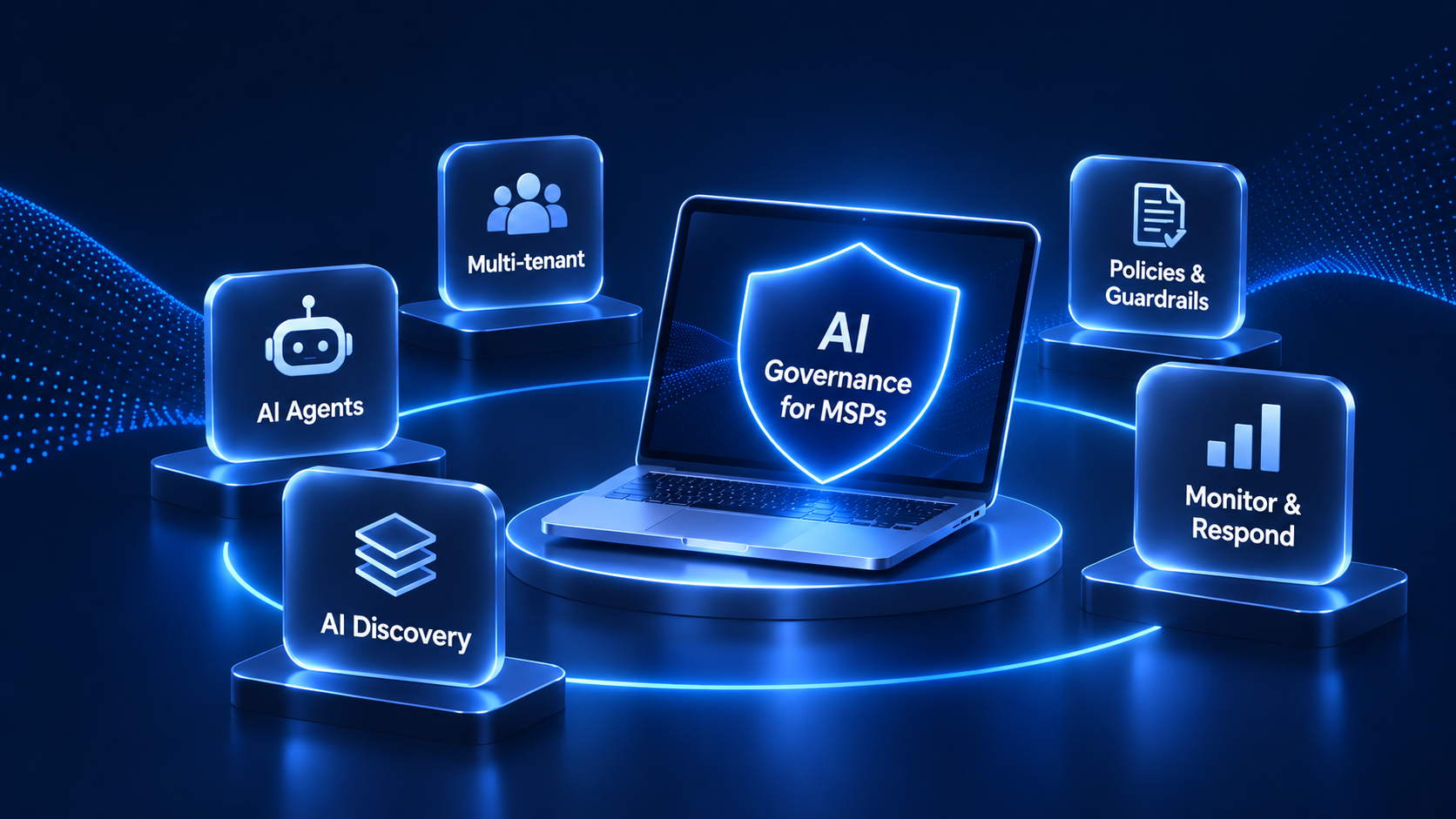
Kipling Secure is an AI Detection & Response platform built for MSPs and SMBs. It brings AI discovery, assessment, governance and response into a platform designed to support managed AI security services.
The platform follows five stages:
- Discover: Identify AI applications, Shadow AI and AI usage across customer environments. Track activity by user, device, location and client.
- Assess: Understand AI exposure through activity context, investigations, exposure reports and executive dashboards.
- Govern: Establish approved AI application lists, data policies, governance controls and compliance workflows.
- Respond: Identify unauthorized AI usage, policy violations and sensitive data exposure, with alerts and remediation capabilities.
- Monetize: Build services around AI risk assessments, governance programs, compliance reviews and ongoing AIDR.
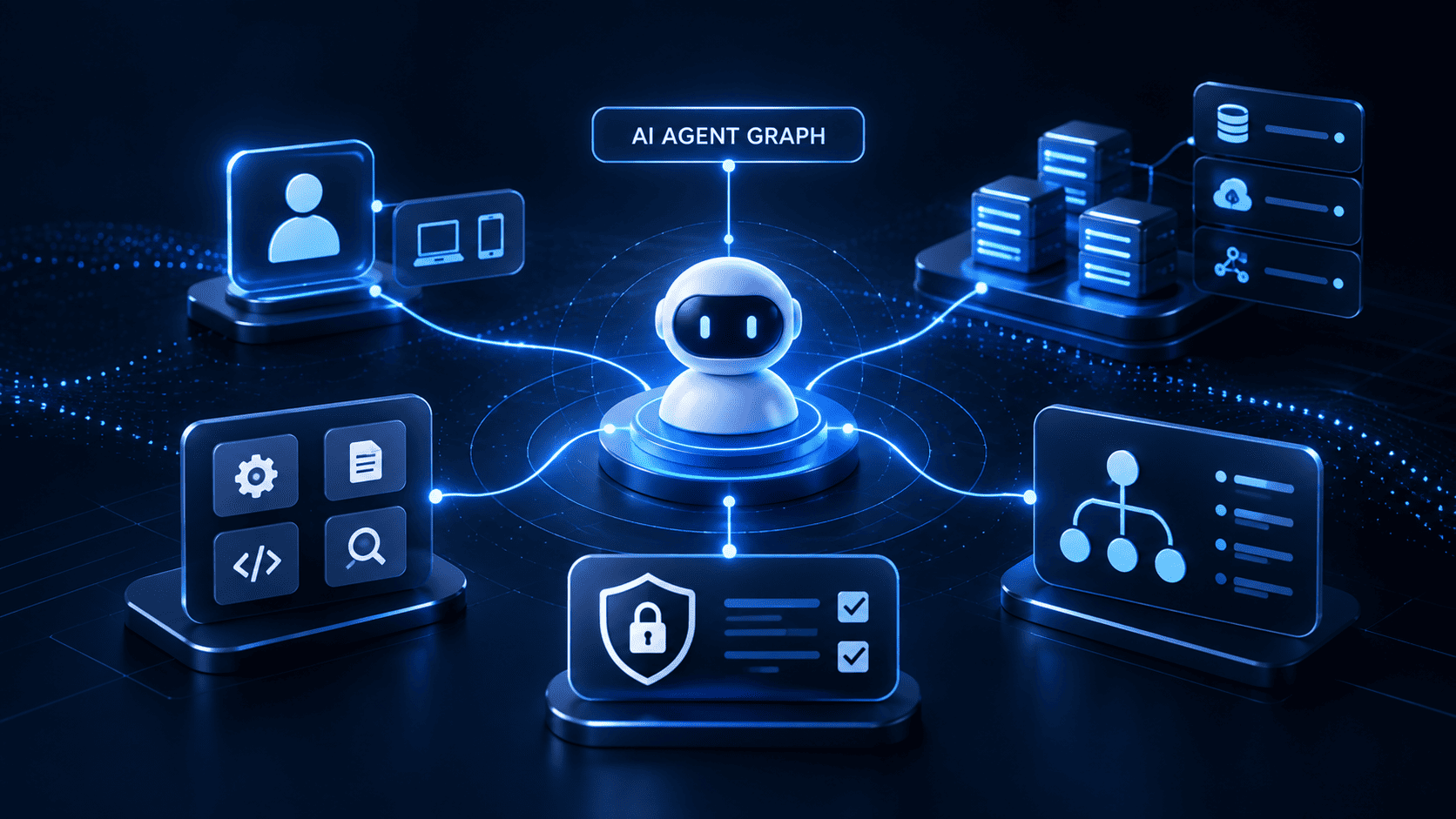
Kipling Secure also extends visibility into AI agents and MCP-connected environments. Its AI Agent Discovery and AI Agent Graph help MSPs understand the relationships between users, agents, MCP servers and connected tools.
This matters because AI governance is moving beyond knowing which applications employees use. MSPs increasingly need to understand what AI systems can access and what actions they can perform.
Kipling Secure is designed to help MSPs deliver this visibility and oversight across customer environments, while building an ongoing AI security service around it.
Conclusion: AI Governance Needs More Than Policies
AI adoption is expanding across applications, departments and business systems. As organizations move from experimenting with AI assistants to deploying connected agents and AI-powered workflows, the challenge is no longer simply deciding which tools employees can use.
Organizations need to understand what AI is being used, what information it can access, which policies apply and how risks are monitored over time.
For MSPs, this creates a new area of responsibility that connects cybersecurity, compliance and strategic advisory services.
The right AI governance platform should provide more than an inventory or a collection of policy documents. It should help MSPs discover AI usage, assess exposure, implement guardrails, monitor activity and communicate risk across customer environments.
Kipling Secure brings these capabilities together in an AI Detection & Response platform built for MSPs.
Discover. Govern. Control.
Explore Kipling Secure and see how to build AI security services for your customers.
FAQs
Find answers to the most common questions about AI detection and response (AIDR), how it works, and why it matters for modern MSPs.