
Over the last decade, managed security services have undergone a significant transformation. MSPs evolved from traditional IT support providers into strategic security partners, services expanded beyond endpoint management and infrastructure support to include cybersecurity monitoring, compliance consulting, vulnerability management, security awareness training, and vCISO offerings.
This evolution happened because customer needs changed. Organizations faced new threats, cloud adoption accelerated, compliance requirements increased, and cybersecurity became a board-level concern.
Artificial intelligence is now creating another inflection point. Businesses are adopting AI faster than any previous technology shift. Employees are using generative AI tools, developers are integrating AI assistants into workflows, and business applications are embedding AI capabilities by default. As AI adoption accelerates, customers are beginning to ask a new set of questions, questions that traditional managed security services were never designed to answer. This is where AI security is emerging as the next evolution of managed security.
AI is changing the security conversation
Historically, cybersecurity discussions focused on protecting systems. Organizations wanted to know: Are our endpoints protected? Are attackers in our network? Are our users vulnerable to phishing? Are we compliant with regulatory requirements? These questions remain important.
However, AI introduces a new layer of complexity. Organizations are increasingly asking which AI tools employees are using, whether sensitive information is being shared with AI, how to identify Shadow AI, what governance policies to implement, how to monitor AI activity, and what AI-related risks to prioritize. These are not traditional cybersecurity questions, they're AI governance and AI security questions. For MSPs, this represents a significant shift in customer expectations.
The visibility gap most organizations don't see
One of the biggest challenges facing organizations today is that AI adoption often occurs without formal oversight. Employees discover AI tools on their own, departments experiment independently, applications introduce AI capabilities automatically, and developers integrate AI assistants into workflows. The result is often widespread AI usage before leadership fully understands what's happening.
This creates a visibility gap. Many organizations cannot answer basic questions such as how many AI tools are in use, which employees are using them, what information is being shared, and whether organizational policies are being followed. Without visibility, organizations struggle to govern AI effectively, and this challenge has become one of the primary drivers of demand for AI security services.
Related Reading: → Shadow AI: The Hidden Threat Already Inside Your Organization
Why traditional managed security services have a blind spot
Managed security services were designed to address well-understood threats, malware, ransomware, phishing, unauthorized access, vulnerability management, and network threats. These remain important. The challenge is that AI-related risks often don't look like traditional security incidents.
An employee uploading customer data into an AI platform does not resemble malware. A developer sharing source code with an AI assistant doesn't trigger a traditional security alert. A marketing team using an unauthorized AI application may never appear in a vulnerability scan. Yet all of these activities may introduce risk. The issue is not necessarily compromise — it's visibility, governance, and data exposure. This is why many MSPs are beginning to recognize that AI security requires new capabilities alongside existing cybersecurity services.
Related Reading: → Why Traditional Cybersecurity Tools Can't Protect Against AI Threats
What AI security for MSPs actually includes
One of the biggest misconceptions surrounding AI security is that it represents an entirely separate discipline. In reality, AI security builds upon many existing cybersecurity principles, the difference is that those principles are applied to new risks and new technologies.
AI Visibility Before organizations can govern AI, they need visibility into how AI is being used, across AI applications, browser extensions, embedded AI features, AI agents, and AI-powered workflows. Visibility provides the foundation for every other AI security activity.
Shadow AI Discovery Many organizations are surprised to discover how much AI activity already exists within their environment. Shadow AI discovery helps identify unauthorized usage, unapproved tools, emerging governance risks, and policy violations, often becoming the first step toward responsible AI adoption for a customer.
AI Governance Governance helps organizations define acceptable AI usage, data handling requirements, risk management processes, user responsibilities, and compliance expectations. Strong governance enables organizations to adopt AI confidently rather than reactively.
AI Risk Monitoring AI adoption creates new categories of risk involving data exposure, AI misuse, compliance concerns, prompt injection attacks, and AI-assisted fraud. Monitoring helps organizations identify issues before they become incidents.
AI Security Awareness Technology alone cannot solve AI-related challenges. Employees need practical guidance on responsible AI usage, sensitive data handling, governance requirements, and AI-related security risks. As AI adoption grows, education becomes increasingly important.
The rise of managed AI security
Just as managed detection and response (MDR) emerged in response to evolving cybersecurity threats, managed AI security is beginning to emerge as a new service category. Organizations increasingly need help with AI visibility, governance, risk management, compliance, and monitoring, and most SMBs lack the internal expertise required to manage these responsibilities effectively.
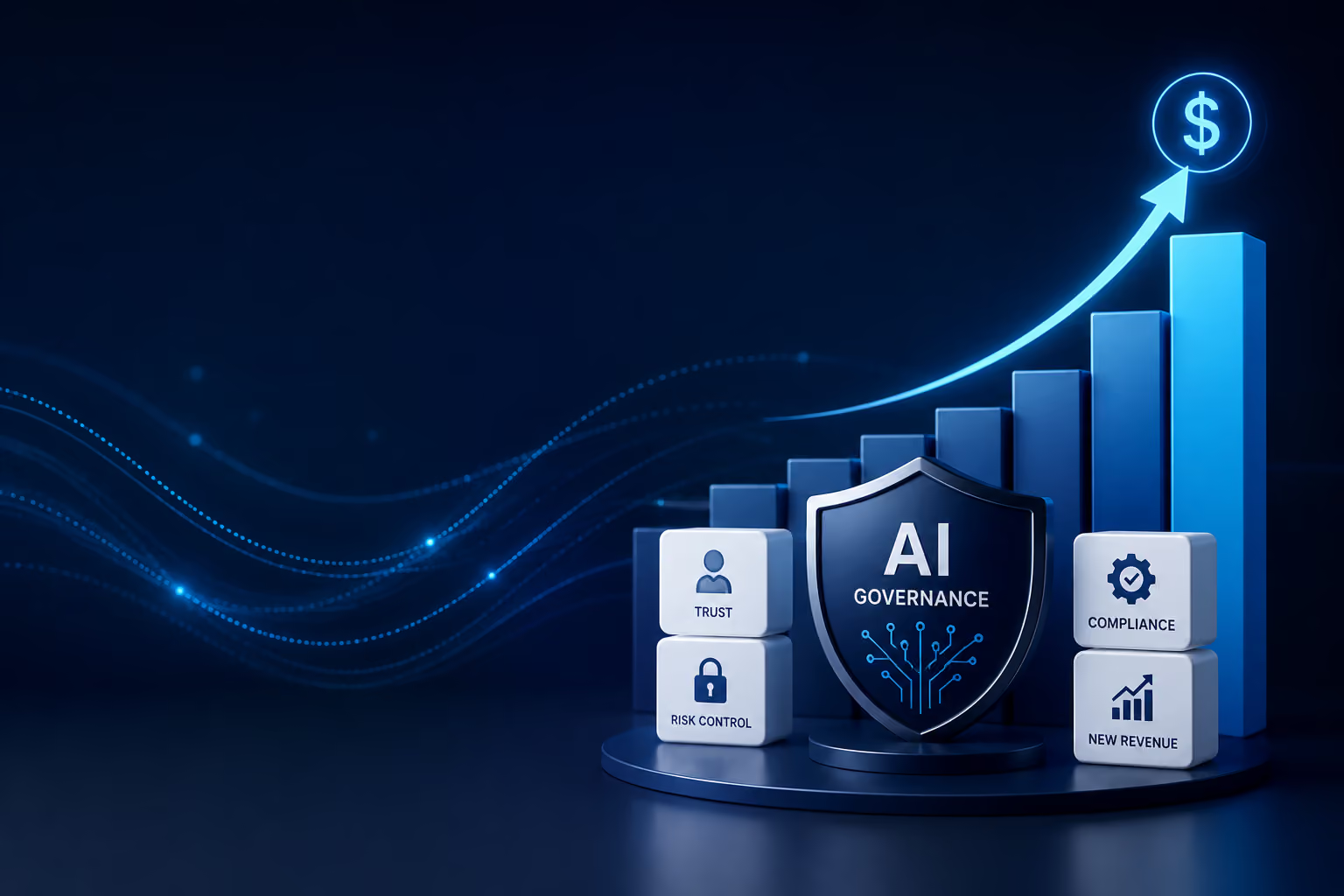
As a result, MSPs are uniquely positioned to provide guidance, creating opportunities for new recurring revenue streams, higher-value advisory engagements, expanded security services, and stronger customer relationships. The MSPs that develop these capabilities early will likely have a significant competitive advantage.
Related Reading: → How MSPs Can Turn AI Governance Into a New Revenue Stream
Why AI security is becoming a strategic service
One reason cybersecurity evolved into a major managed service category is that risk never stands still. AI follows a similar pattern, new tools emerge constantly, user behavior changes, governance requirements evolve, and threat actors adapt. Organizations need ongoing guidance rather than one-time projects, which makes AI security particularly well-suited to the managed services model.
The conversation shifts from "Can you fix this problem?" to "Can you help us manage this risk continuously?" That transition creates long-term value for both customers and providers.
The future of AI detection and response
As AI adoption matures, organizations will increasingly require capabilities that extend beyond visibility, the ability to identify risky AI behavior, sensitive data exposure, policy violations, AI-specific threats, and governance gaps in real time. This is where concepts such as AI Detection and Response (AIDR) begin to emerge.
Just as MDR transformed cybersecurity operations, AIDR platforms and AI-focused monitoring and response capabilities are likely to become increasingly important over the next several years. Organizations that establish visibility today, through an AI Visibility Assessment and an ongoing AI Exposure Score, will be far better positioned to respond tomorrow.
Related Reading: → What Is AI Detection and Response (AIDR)?
.avif)
Conclusion
AI is not replacing cybersecurity. It's expanding it. Organizations still need protection against malware, phishing, ransomware, and countless other threats. However, they also need visibility into AI usage, governance around AI adoption, and controls designed to address AI-related risk.
For MSPs, this creates a significant opportunity. The providers that embrace AI security today will be better positioned to meet customer expectations tomorrow. The next evolution of managed security services is already taking shape, and AI security is rapidly becoming part of that future.
.avif)
FAQs
Find answers to the most common questions about AI detection and response (AIDR), how it works, and why it matters for modern MSPs.